
Ceramic Kaleidoscope by Teruko Tsuji
Josei tōgei-ka no kusawake to shite senzen yori daiissen de katsuyaku shita, tsuji teruko (1920 - 2017) no kichōna mangekyō sakuhindesu. Genpin 1-ten kagiri no tokubetsuna go shōkai to narimasu.
This is a rare kaleidoscope created by Teruko Tsuji (1920–2017), a pioneering female ceramic artist who was a leading figure in her field from the pre-war era onwards. We are offering this unique, one-of-a-kind piece.
── A Childhood Dream Realized 60 Years Later
Teruko Tsuji first encountered a kaleidoscope when she was still a young girl attending kindergarten. Her father, Seikichi, brought home a beautiful kaleidoscope made in Europe, and she was captivated by its enchanting patterns and colors. From that moment on, she dreamed of one day creating a kaleidoscope of her own. It took nearly 60 years for that childhood dream to become reality. Tsuji was already in her seventies when she finally brought her vision to life. Her richly textured ceramic tubes, lovingly crafted through her own pottery work, were paired with intricate optical designs created by a kaleidoscope artist she trusted. This unique collaboration between ceramics and kaleidoscope-making gave rise to her distinctive ceramic kaleidoscopes. Her work has earned widespread recognition for its artistic excellence. At the Sendai Kaleidoscope Art Museum in Miyagi Prefecture, Japan, which brings together kaleidoscopes from around the world, a dedicated permanent exhibition space known as the Teruko Tsuji Gallery continues to celebrate her creations. This special gallery was established through a remarkable connection between Tsuji and the museum's founder and director, Hironori Ochi.
Loving Nature, Capturing Its Essence: The Art of Sketching Praised by Rosanjin Kitaoji
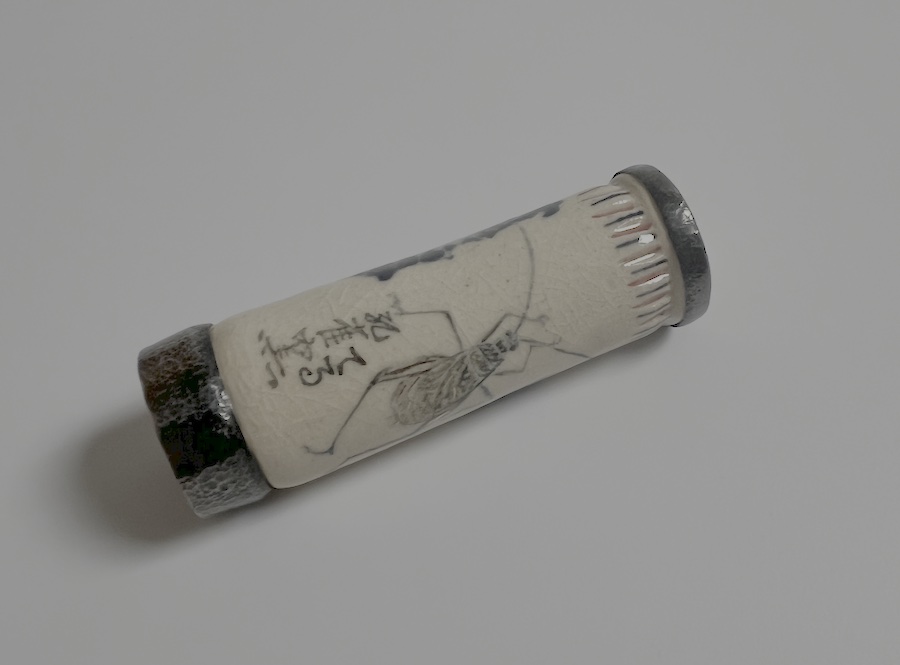
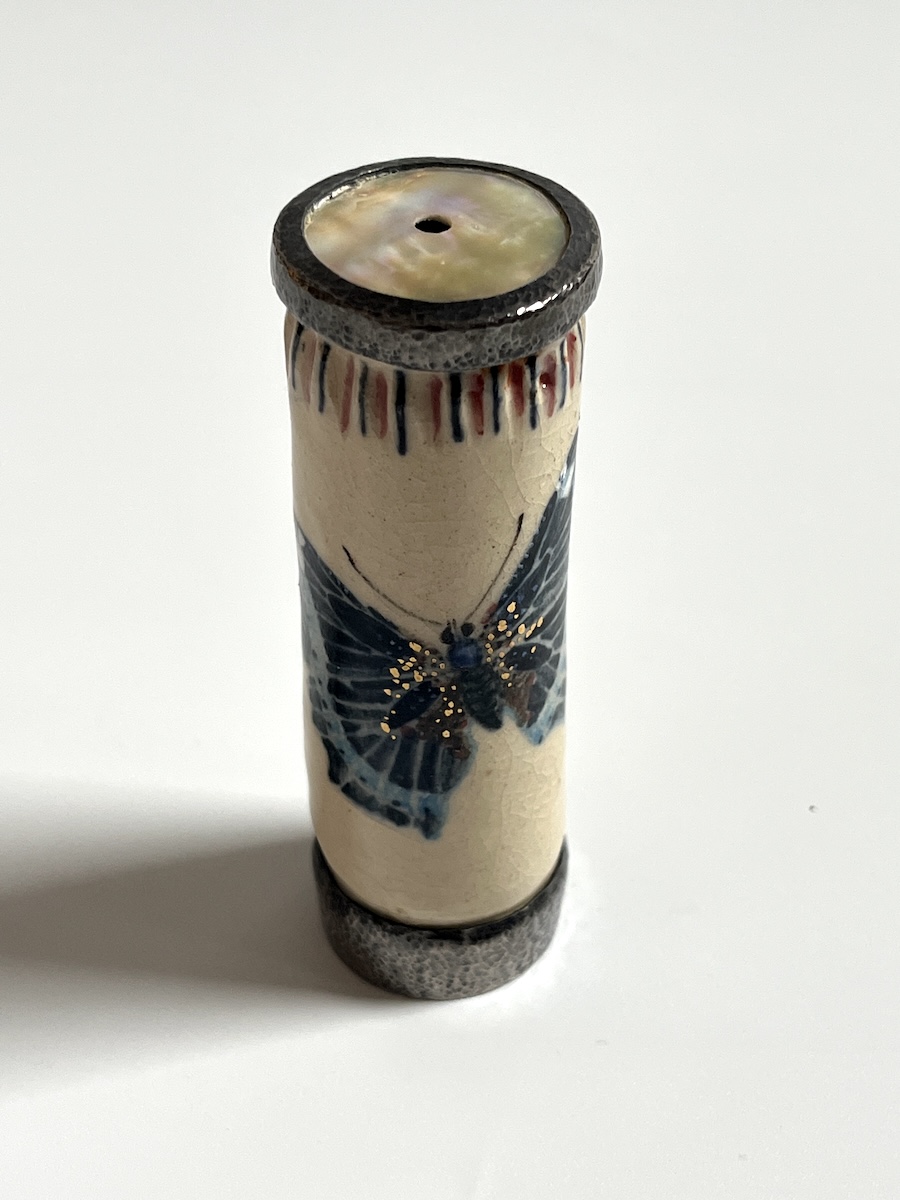
“Whatever the art form, what matters is how deeply one loves nature and how well one captures its essence. That is why one must begin with sketching from life.” — From The Beauty of Ceramic Art in Bloom: The Story of Teruko Tsuji — These words come from a letter that the renowned Japanese artist and ceramicist Rosanjin Kitaoji wrote to Teruko Tsuji when she was still a young woman. Even well into her eighties, Tsuji reportedly never missed her morning practice of sketching wildflowers, birds, and insects during her daily walks. Decades of patient observation and dedicated practice are vividly brought to life in this ceramic kaleidoscope, where the spirit of nature seems to breathe through the artwork. The creatures depicted on the ceramic body of this piece appear to be a Common Bluebottle butterfly and a bell cricket. With all unnecessary ornamentation stripped away, the two creatures are arranged in exquisite balance, lending the piece an understated elegance and a refined sense of share—the distinctly Japanese art of subtle, sophisticated charm.
A Kaleidoscopic Life: Encounters with the Great Masters of Art
Teruko Tsuji shared close and meaningful relationships with many of the towering figures of Japan’s artistic and literary worlds during the Showa era, including Rosanjin Kitaoji, Taro Okamoto, Ken Domon, Hazan Itaya, Kenkichi Tomimoto, and Yasunari Kawabata.
The vivid stories of her encounters with these remarkable figures, along with the extraordinary, almost miraculous events that unfolded throughout her life—including a particularly fascinating tale involving a ceramic panel painting of a work by Vermeer—are as captivating and unpredictable as the kaleidoscopes she so dearly loved.
Just as each turn of a kaleidoscope reveals a fleeting world of patterns that will never appear quite the same way again, the ever-changing beauty of these momentary encounters mirrors the remarkable course of Tsuji’s own life.
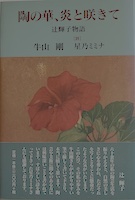 Book「陶の華、炎と咲きて 辻輝子物語 (The Beauty of Ceramic Art in Bloom: The Story of Teruko Tsuji) 」
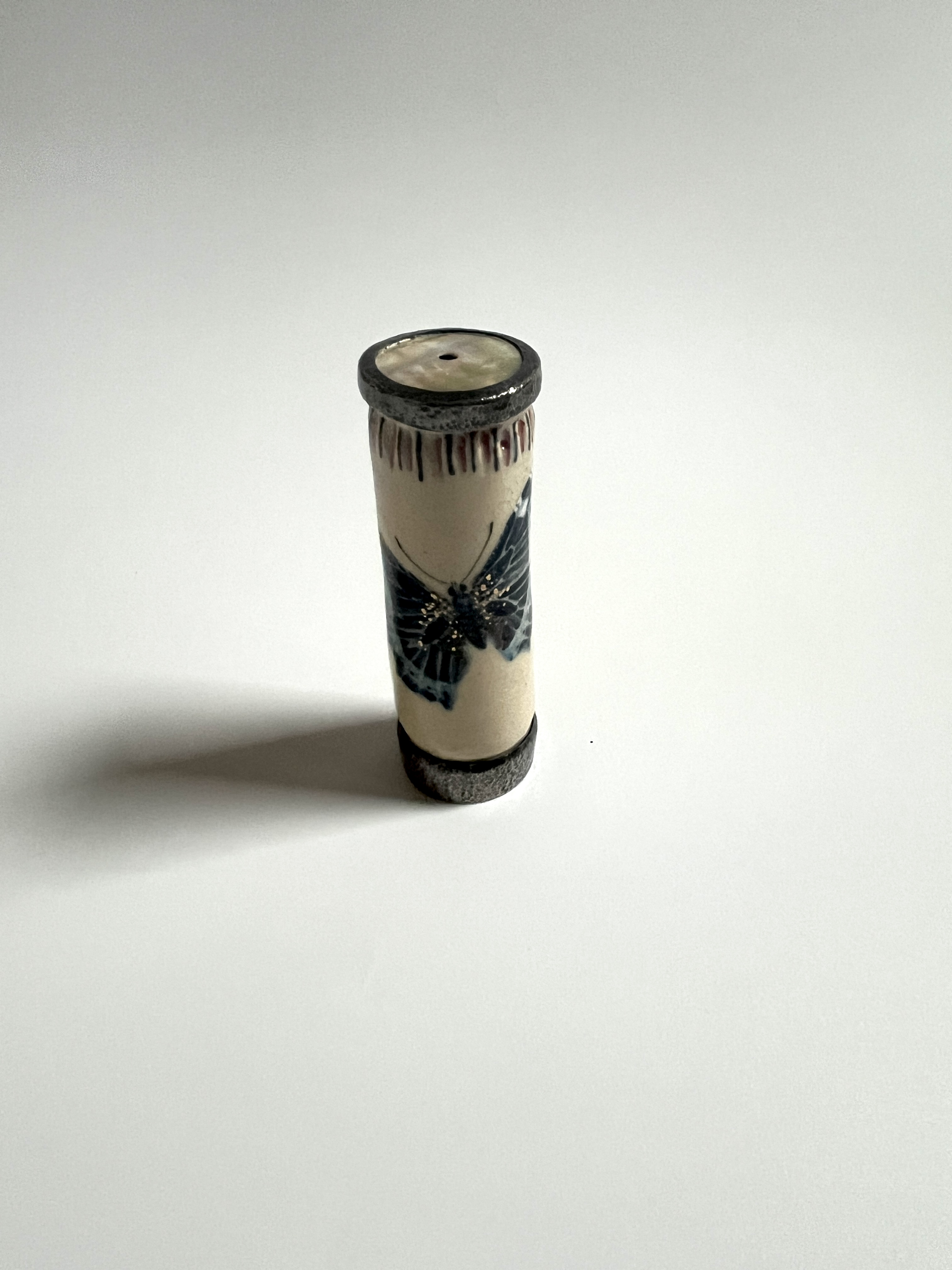
Ceramic Kaleidoscope by Teruko Tsuji
Price : ¥300,000 (+shipping)
>>>View Purchase Guide & Order via Email
●Dimensions and Weight (approx.):
Diameter: 34 mm x Length: 105 mm
●Weight: 120 g
●Shipping: Charged at actual cost
●Date of Creation: Circa 1993–2006
●Availability: A unique, handmade piece. Only this one is available.
*If you have any questions or would like further information, please feel free to contact us.
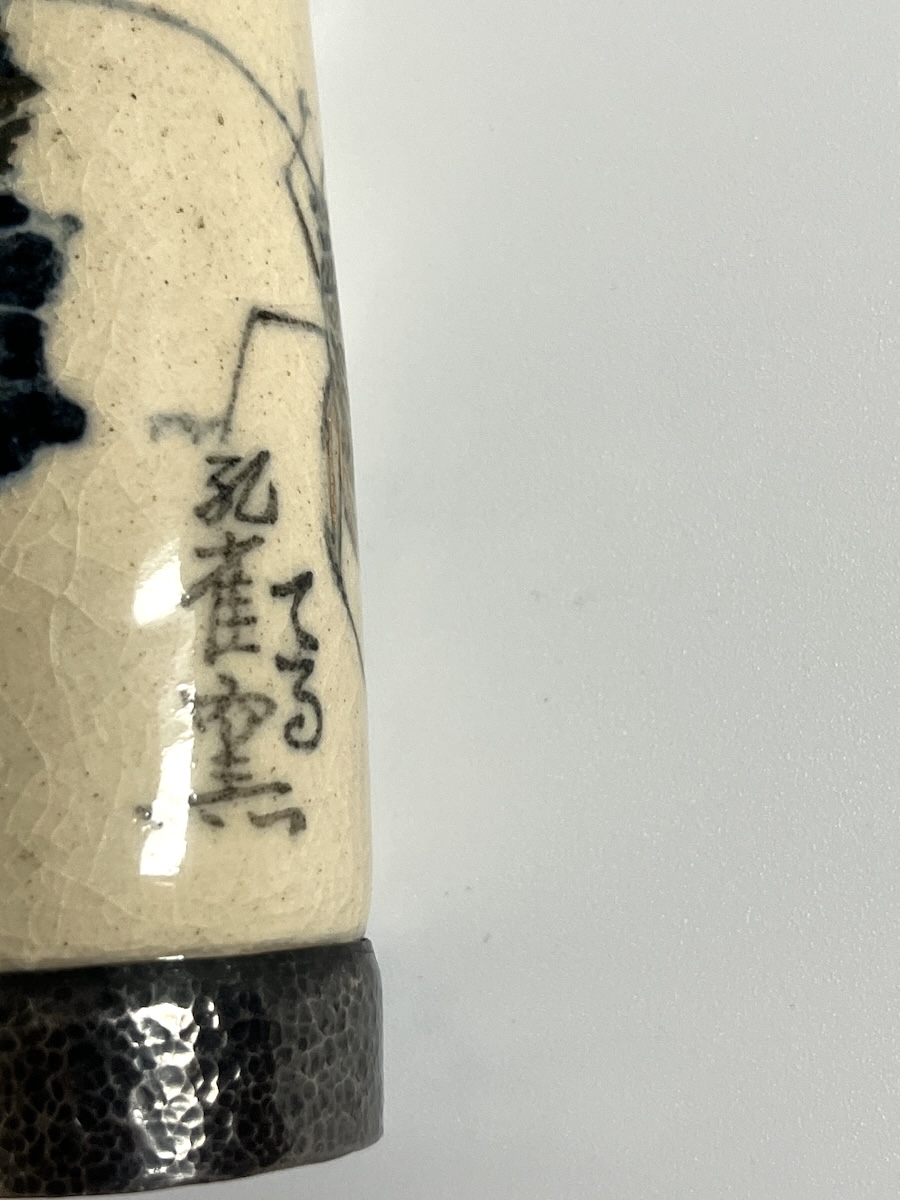
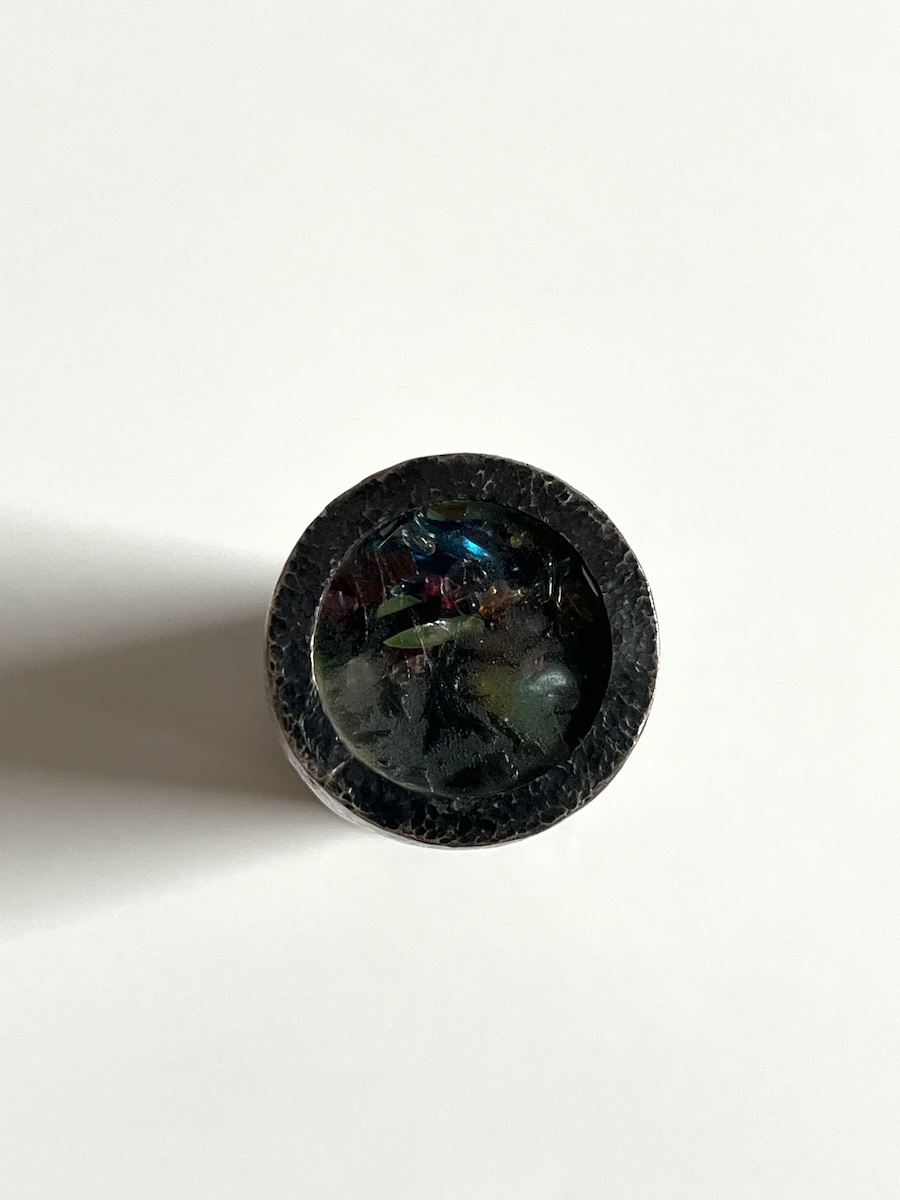
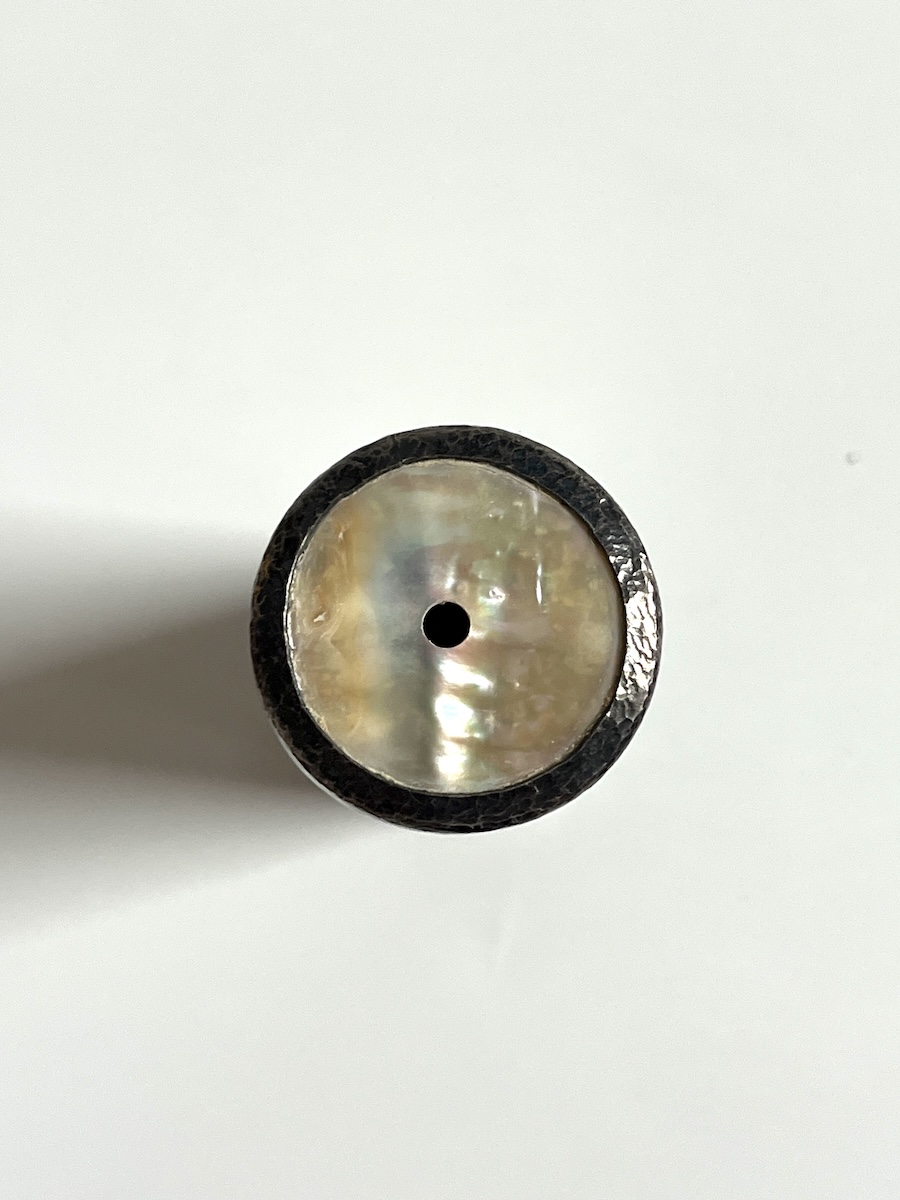
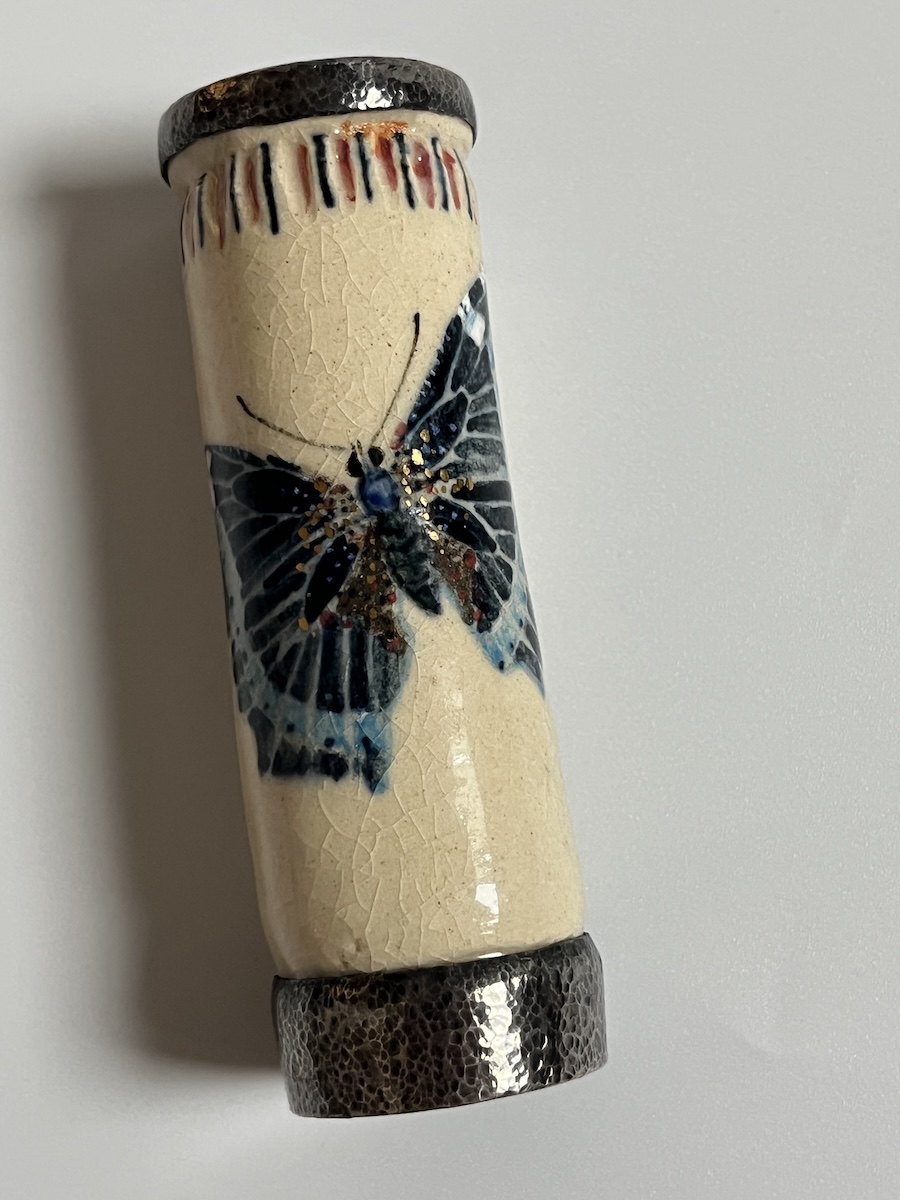
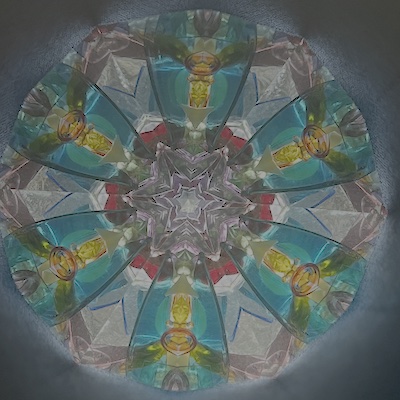
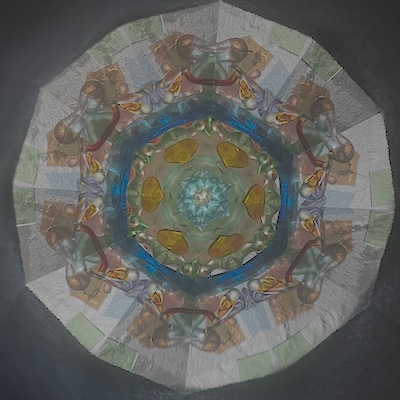
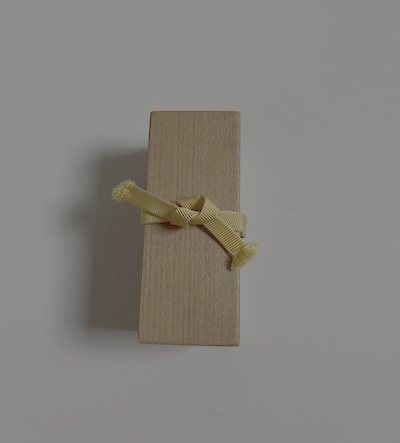
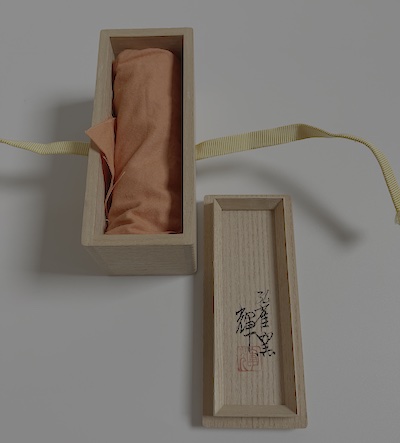
By a fortunate twist of fate, this kaleidoscope has found its way into my hands.
Its body is a small ceramic tube, shaped from earthy clay, with a wonderfully warm character that strikes a delicate balance between rustic simplicity and refined elegance. A butterfly and an insect, rendered with a keen appreciation for the beauty of life, adorn its surface. Compact enough to fit in the palm of your hand, it is a treasure of modest size and extraordinary charm.
The top of the tube is capped with what appears to be white mother-of-pearl. A tiny hole pierces the cap. Peer inside, and a vivid world of colorful light unfolds before your eyes.
Now, gently turn the tube. Round and round. Brilliant flecks of color overlap, drift apart, and rearrange themselves into ever-changing patterns. No batteries or charging required. In an instant, a dazzling labyrinth of light transforms before your eyes.
—
I once had the opportunity to meet Teruko Tsuji in person. She must have been well into her eighties at the time. Like a star whose gravitational pull draws planets into its orbit, she was surrounded by people drawn to her presence. Her smile was as charming and radiant as that of a young girl.
Even now, this little kaleidoscope seems to hold within it the same dazzling energy I felt in her presence that day.
I invite you to experience this beautiful, one-of-a-kind work for yourself, alongside the book The Beauty of Ceramic Art in Bloom: The Story of Teruko Tsuji.
— The Owner
辻輝子 TSUJI Teruko
Born in 1920 in Nihonbashi, Tokyo. Her younger brother was the ceramic artist Seimei Tsuji.
She studied ceramics under Mitsuhiko Omori and Kenkichi Tomimoto, as well as under Issei Mori in Kutani ware, and studied Japanese-style painting under Kinshiro Asaka.
In 1939, she exhibited her work at the New York World's Fair. In 1952, she organized a performance of classical Indian dance by Priya Gopal at the Imperial Theatre in Tokyo.
In 1978, she organized a homecoming exhibition of incense containers from the Clemenceau Collection, bringing these works back to Japan for exhibitions at six venues nationwide, including Nihonbashi Takashimaya. She went on to pursue a wide range of cultural and artistic activities, including serving as Honorary Director of the Sendai Kaleidoscope Art Museum, which opened in 1999.
Her honors and achievements include receiving the Special Prize at the Tokyo Metropolitan Craft Exhibition twice. In 1978, one of her works was purchased by Her Imperial Highness Princess Chichibu. In 1980, 1981, and 1985, her works were purchased by the Imperial Household Agency.
Her work was exhibited extensively both in Japan and abroad, including in numerous museum exhibitions.
She passed away in 2017 at the age of 97.